Week-to-Week: WWE Raw Live vs. WWE Raw Live on Netflix
How Netflix's investment in weekly ritual is—or isn't?—reshaping the WWE product
Welcome to Week-to-Week, the newsletter of Episodic Medium covering the media industries by me, Myles McNutt. To receive future newsletters and keep up-to-date on the shows we're covering weekly for our paid subscribers, join our mailing list.
You can also get 20% off yearly subscriptions to the newsletter through our annual subscription drive. You can find more information here.
Professional wrestling is a ritualistic narrative form. WWE draws its fandom from the rhythms of tuning in each week to follow the high energy soap opera, and many in its audience have been doing so for decades. In a television climate where live sports are one of the last good investments, the WWE has leveraged its commitment to ritual into lucrative contracts: in 2023, NBCUniversal paid $1.4 billion for the rights to Friday Night Smackdown for five years, up from the $1 billion Fox paid for those rights in the previous agreement of the same length.
Given this, it wasn’t necessarily surprising that Netflix emerged as the highest bidder for the rights to WWE’s flagship weekly program Raw around the same time. Netflix has made live events a crucial part of its efforts to diversify its programming, and the ritual engagement of WWE fans is a reliable draw. Although ESPN’s purchase of Premium Live Event (PLE) rights in the U.S. meant that Netflix isn’t the exclusive home for WWE’s programming in the region, Raw is the more durable ritual at the end of the day. Back in my days as a teenage wrestling fan, I wasn’t buying every pay-per-view, but I was absolutely watching every episode of Raw, and that’s the kind of tune-in Netflix is hoping for in its live era.
However, despite following the WWE a bit more closely in the year and a half since Raw debuted in Netflix in early 2025, I have to be honest: I tuned into the premiere and haven’t been watching otherwise. Some of this is that I had fallen out of the ritual decades earlier, and some of it is not really viewing Netflix as a “ritual” platform: the idea of “tuning in” to a live event on streaming still hasn’t clicked for me in most cases. Moreover, as I wrote about when I covered WWE: Unreal, my TikTok For You Page has passively fulfilled a crucial part of the ritual viewing of Raw: tracking the soap opera storylines that feed into the PLEs. While the internet has always made this kind of “following” of wrestling possible, now it comes in the form of reaction videos and social media clips that give you the highlights without needing to log into Netflix at a specific time.
 Myles McNutt
I’m not suggesting that Raw has been unsuccessful on Netflix: its roughly 2.4m views each week regularly place it in Netflix’s Top 10 (although it fell off for last week's pre-taped episode). But I’ve often wondered whether the show’s presence on such a broad-skewing platform has changed its place in the cultural consciousness. It’s much easier for someone to “stumble” onto Raw than it was before, especially for younger viewers who wouldn’t have been cable subscribers. Combined with the aforementioned social media dynamics, Raw on Netflix feels like less of a ritual viewing experience and more like a constant point of entry for new viewers, a sort of plussed version of what YouTube and other social media platforms have been doing with clips and recaps for years.
But is that point of entry substantial enough to draw their interest? Not unlike the mid-week episodes of a daily daytime soap opera, the average episode of Raw is pretty light on meaningful story development: if you’re not seeing an episode immediately before or after a PLE, most episodes of Raw could in fact be an email. The August 10 episode of Raw, which was the second after the two-night Summerslam PLE, was full of transitional story beats. Solo Sikoa fought for his freedom from the Bloodline and lost, yet that simply meant he will be “delivered” to Roman Reigns…the next week. Oba Femi emerged to confront Bron Breakker…but they were separated by officials because they could lay a hand on each other. LA Knight literally spent the entire night backstage ranting about his feud with Roman Reigns, which couldn’t progress further because the Original Tribal Chief was absent from the evening’s event. It was a bunch of moments built around delaying or setting up the moments fans are truly waiting for, many of which culminate on tonight’s Raw from Mexico City (including the #1 Contenders Luchador tournament that started that night and concludes with Penta vs. Roman Reigns this evening).
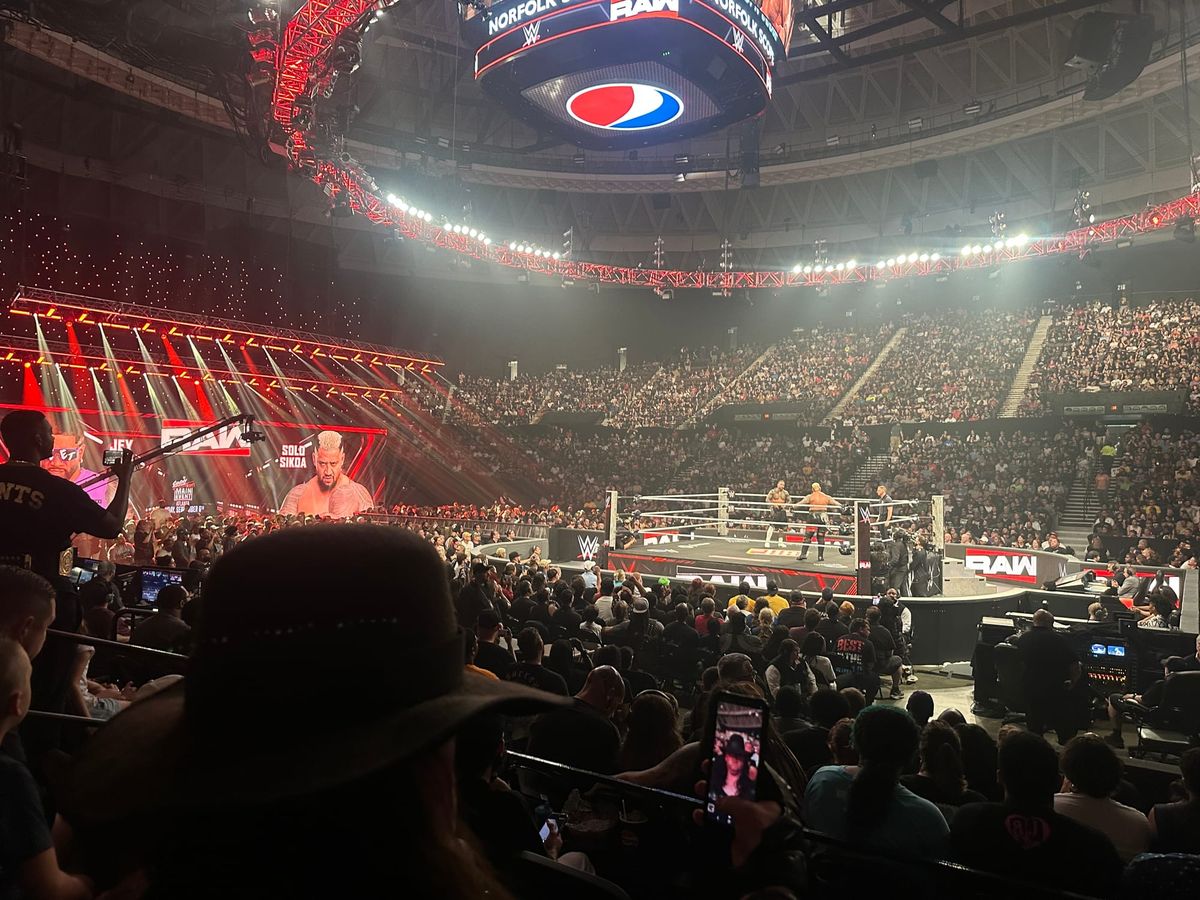
I don’t have an answer to the question of whether an episode like the one on August 10 would appeal to a new fan, but I was thinking about the topic when I realized I had a good excuse to investigate further. On that evening, Monday Night Raw was broadcast live from my home in Norfolk, Virginia—there have been a number of WWE shows at the Scope Arena downtown since I moved here a decade ago, but I was never following wrestling closely enough to justify attending. With a slightly renewed interest in the product, I reached out to Netflix, and they were able to secure tickets to witness an episode of Raw first hand. It was my first WWE show in 17 years, and you have to go back to 2003 for the last (and only) time I was able to attend a Raw taping. It was thus my first time viewing the TV taping experience through a more critical lens, and I was struck by how the broadcast ritual I was so familiar with intersected with a live ritual that I realized I have maybe been taking for granted.
As noted, the weekly ritual of watching Raw is a powerful one, but it’s also fairly casual. There’s a comfort in the familiarity of dropping in on the story each week, but the limitations of that story in each episode means that it doesn’t necessarily have a huge fervor behind it. While the same characters might appear in an episode of Raw or a PLE, Raw is typically going to give you less time with your favorite superstar; there’s a difference between seeing them face off with their arch-rival and seeing them cut an in-ring promo, after all.
But if you’re WWE, you need every episode of Raw to theoretically connect with a new viewer, and that largely depends on the crowd in the arena. Even if you’re not going to deliver Roman Reigns, and if fans are going to get only the smallest morsel of story development for Bron and Oba, the crowd needs to be hyped about all of it if a viewer at home—potentially watching for the first time—is going to become invested in those narratives. I was told once by a producer at Late Night with Jimmy Fallon that if we didn’t look like we were having fun behind Lenny Kravitz, the audience at home wouldn’t be able to enjoy it, and it’s a principle that’s especially true given how much wrestlers depend on the emotional dimensions of fans cheering for good guys and booing bad guys.
The good news for WWE is that whereas the weekly ritual of tuning into Raw is a relatively casual one, the ritual of attending live WWE events is much more rarefied. Technically, WWE just did a Smackdown taping in Norfolk in September of last year, but it’s been three years since Raw filmed at the Scope Arena, and there’s a good chance that many people in attendance were seeing a live show for the first time. This is especially true for young fans (shoutout to the father in full Undertaker cosplay and his little girl in front of me), or potentially those fans who stumbled across Raw on Netflix and developed a connection to the product as a result. It’s also very possible that there are some in attendance who might not watch WWE programming on a regular basis, but see an opportunity for a moment of reconnection (although that seems like an expensive night out on something you’re not invested in, which explains why the dude who showed up an hour late next to me and asked aloud whether Dominik Mysterio was related to Rey Mysterio also got his tickets for free from Netflix).
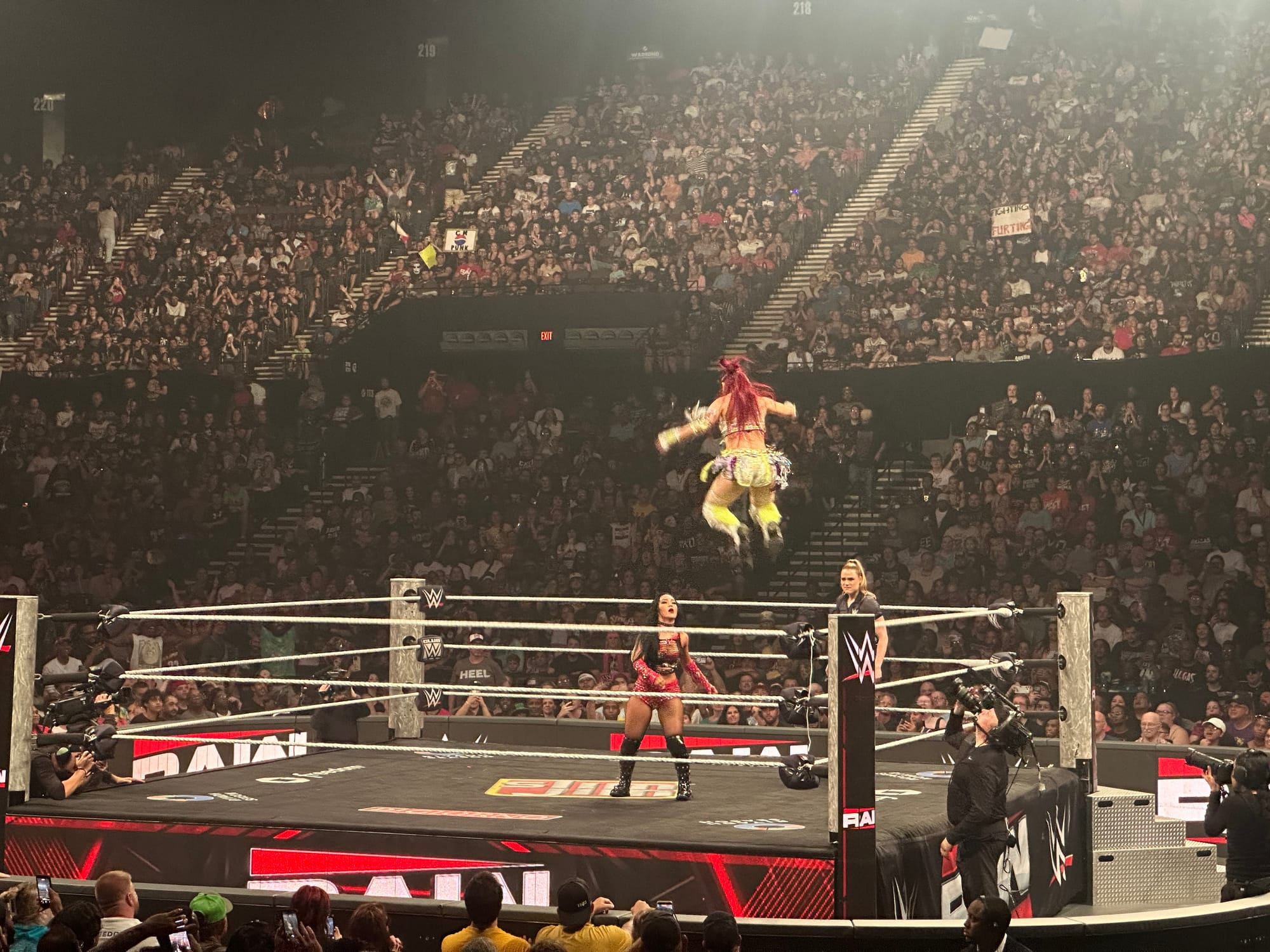
As a result, on average it seemed like a “hot” crowd for much of the show. There were some dead spots here and there, but on the whole you have a crowd of people excited to have Raw come to “their town” fueling a group of people watching at home like it’s just an average Monday. It’s a productive marriage, and while I’m too cynical to fully “mark out” with the rest of the crowd, it was fascinating to see the thrill people got from participating in the on-site ritual. To yeet alone in your living room just doesn’t compare to yeeting with 8000 other people, y’know?
That said, I thought it was interesting to see how WWE works to manage the crowd within the limitations of a live broadcast. This began before the show started, when the large LED screens lit up with something I’d never seen before: an episode of WWE Now, a sports style recap show released on WWE’s YouTube channel setting up the storylines for each episode of their weekly TV shows.
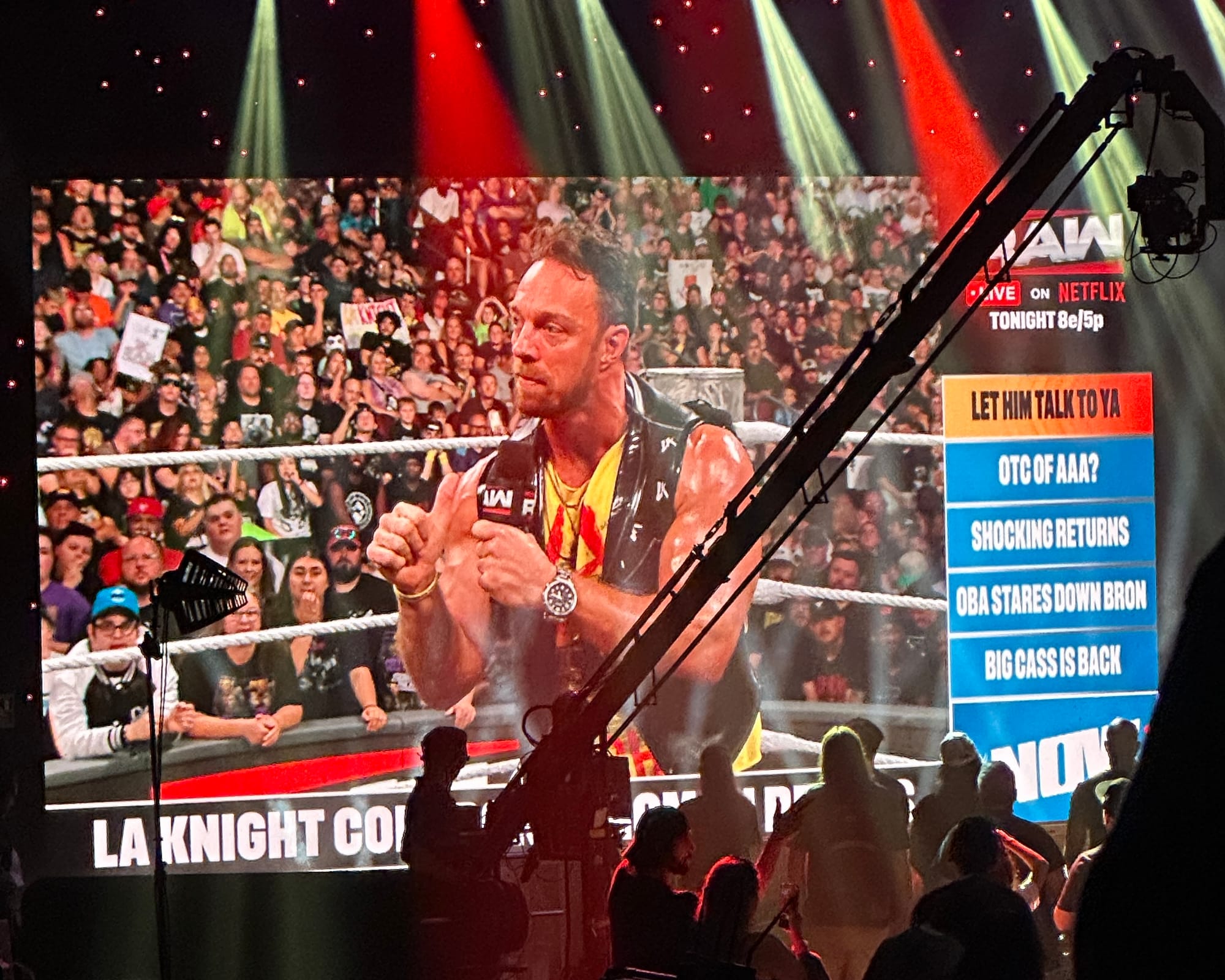
I’d never seen one of these before, and while I wasn’t shocked to see it originated on YouTube, my recollection is that the version we saw in the arena actually addressed fans in attendance directly, calling out Norfolk in one of the first of many mispronunciations as the evening progressed (it’s Nor-fuk, not Nor-folk). Played as it did, it was there to ensure that everyone in attendance knows what to expect even if they missed the last episode, a “Previously On” for the live audience to ensure they weren’t surprised by the fluctuations of good and bad inherent to the program.
Does this entirely resolve the challenges of “heel” and “face” in the context of a live crowd? No. The episode opened with brothers Solo Sikoa and Jey Uso, with the former leaning into his new, comic good guy character while the latter effectively acts as the bitter big brother trying to pull him back into the family. The problem is that Jey caught fire as a singles wrestler while a face, with his “Yeet” crowd interaction a highlight for fans young and old. Throughout the night, you could tell the crowd didn’t know how to react to Jey’s heel behavior, but in the end I expect that the WWE will take whatever energy they can get. Even if it kind of works against their story, they want the Yeeting because they want the merch sales and because they want the crowd to be amped up when they need them to be.
One of the challenges is keeping them engaged while commercial breaks disrupt the experience. It’s an inherent part of a live TV broadcast, and to be honest I don’t even remember what was happening during commercials back in 2003 (I didn't even have a cell phone to check). The commercial breaks during Raw on Netflix have been a topic of much conversation, especially because they are present even for people on ad-free Netflix plans, and are unskippable even when watching an archived broadcast. They’re also a conversation because, notably, Netflix has not been including these ads in all of the countries where they have the streaming rights: certain countries like Australia have ad-free broadcasts.
As a result, there are a variety of ways WWE approaches these commercial breaks during TV tapings. During matches itself, this is achieved by simply ignoring them: we get to see the entire matches, whereas viewers at home miss out on 3 minutes or more somewhere in the middle. This actually resulted in an overall superior experience in person, to be honest: when I rewatched the broadcast on Tuesday morning, matches that had seemed fairly substantial and dynamic in person (see: Penta vs. Laredo Kid) didn’t have the same impact when you were missing three minutes in the middle. I’d actually love if WWE: Unreal could do a whole segment on how they approach developing a “TV Match” that has to have a break in it compared to one on a PLE, because it does require a different storytelling approach so that there can be three minutes of wrestling that entertains the crowd but doesn’t contain anything so substantial viewers at home won’t understand the story of the match.
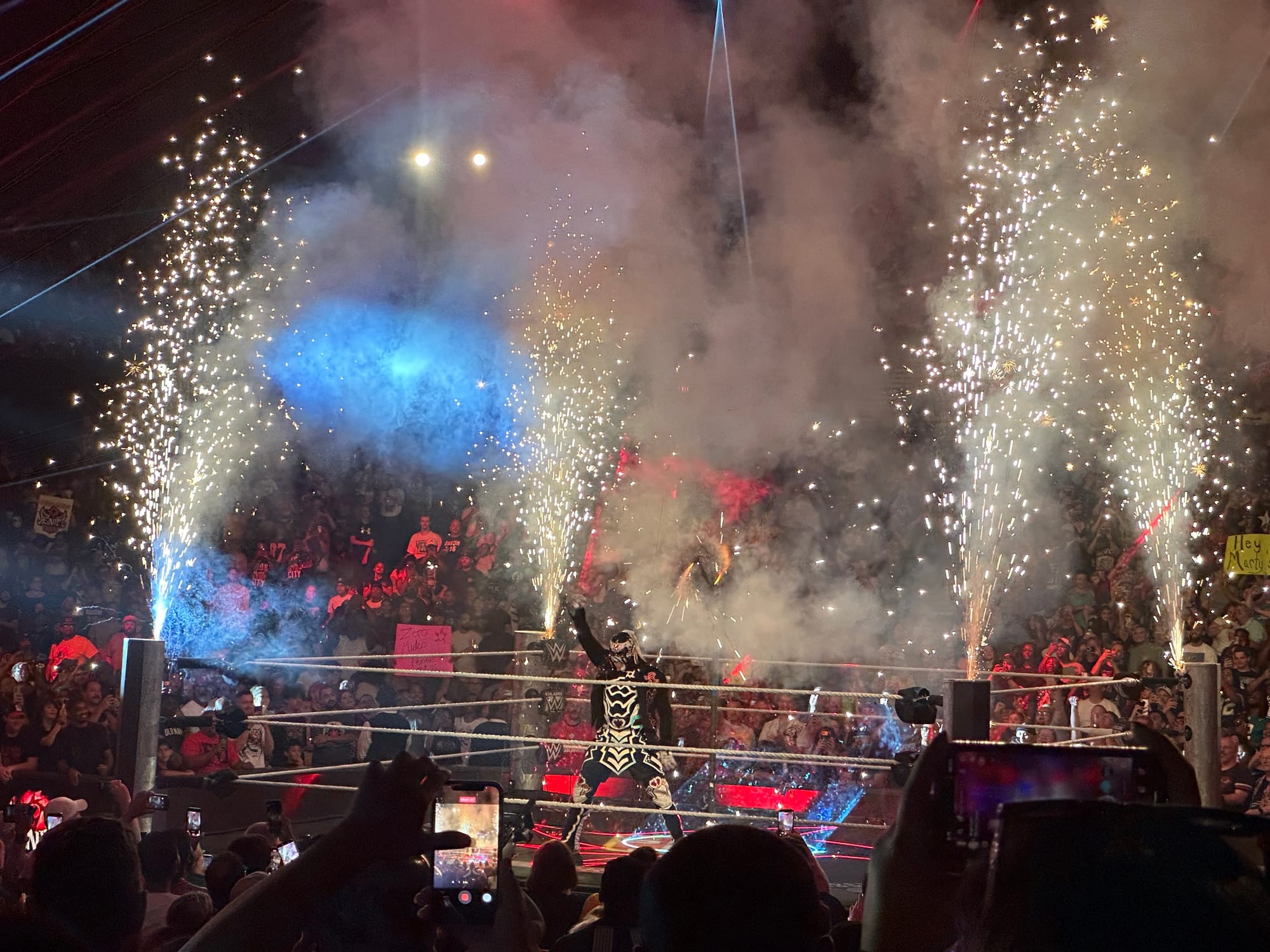
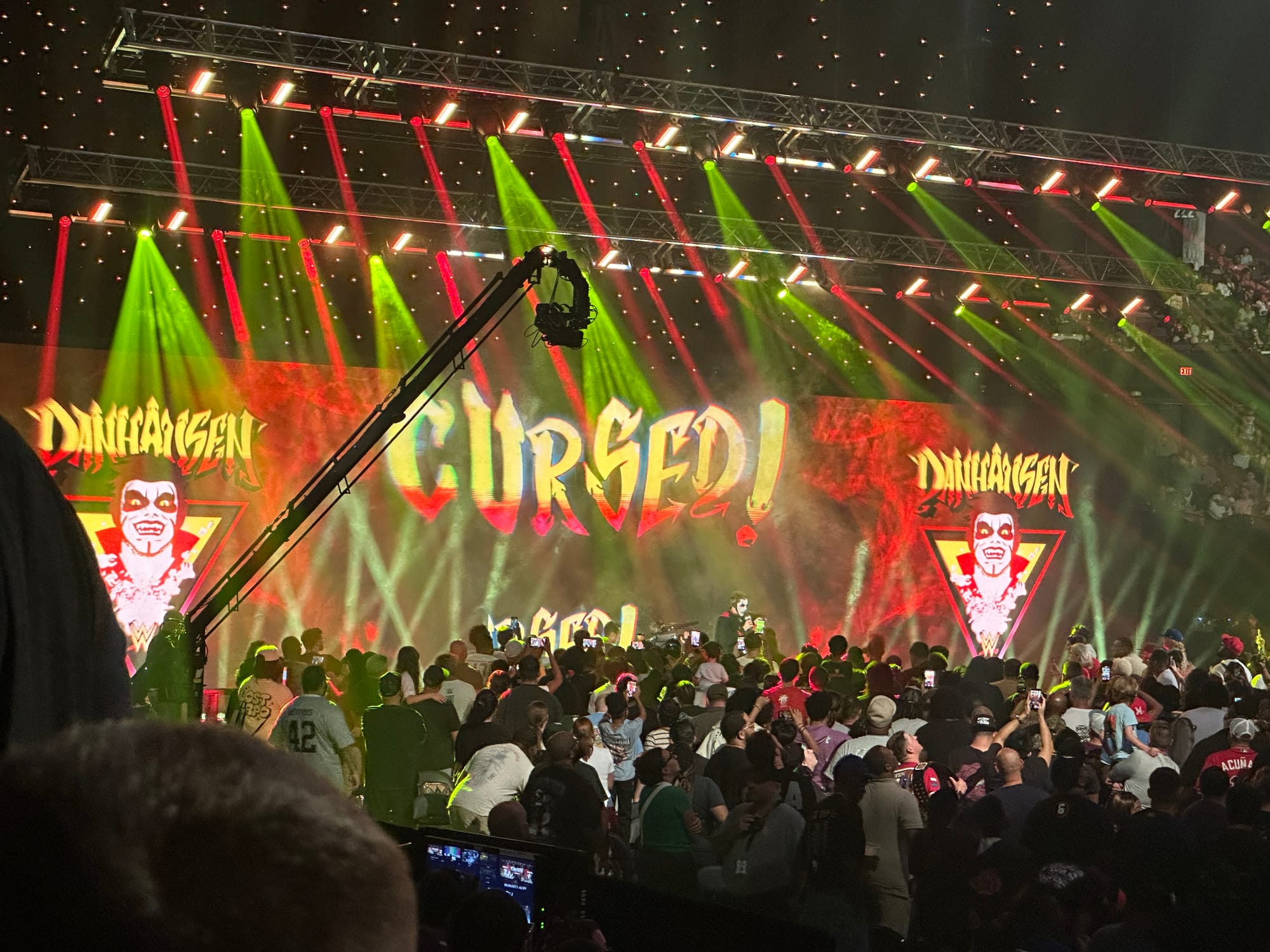
The non-match commercial breaks, though, are more interesting. At three intervals in the program, wrestlers on the Raw roster emerged for promos meant for the live audience. Joe Hendry appeared in the ring to perform a song about giving him all of the belts, Ethan Page came out to talk about how he’s the greatest, and in the most memorable appearance mysterious and mischievous Danhausen emerged to fling t-shirts into the audience and help sell the “You Are Cursed, Norfolk” t-shirts they were shelling pretty hard in the arena (I’m wearing one as I type this, not going to lie). None of the three segments were substantive, and none were linked to ongoing stories: Hendry didn’t specifically mention anyone he’s feuded with (like the injured Logan Paul), and while Danhausen made a backstage appearance during a Sol Ruca interview later in the night, he didn’t mention that during his brief time in front of the crowd. The promos mostly served to keep us entertained while the bills got paid.
@wwe someone is confusedhausen 💀😂 #WWE #Danhausen
♬ original sound - WWE
Except I got confused going through my TikTok “For You” page the day after the event, because there was Danhausen struggling to remember his own catchphrase during his appearance in front of the crowd. The comments were equally confused, asking “why wasn’t this on TV” and “when the fuck was this?” Users speculated that this was based on what plan you’re on, with one explaining that they saw this and the other segments with a “countdown” until the end of the commercial break. However, it’s not a question of plan but rather location: in territories where Raw airs on Netflix but ads are either not allowed or not yet sold, they can’t just show you a blank screen. For those users at home, these interstitial segments are experienced much the same as in the arena, even though the three promos all involved direct callouts to Norfolk that clearly mark them as localized (although WWE putting them on YouTube suggests additional utility).
Alongside the WWE Now sequence, it creates a scenario where the live experience—despite lacking color commentary—is arguably a better overall one. In a smaller arena like the Scope, there’s not really a “bad” seat in the house, and even the Australian Netflix users don’t seem to get the match content replaced by commercials based on the YouTube clips I’ve seen. When I watched it back on TV, I could see how the storylines could connect, but I was also struck by how the commercial breaks disrupted the experience. They were repetitive, and frequent, and ultimately the antithesis of what many users expect from Netflix (he says from the privilege of an ad-free plan). The experience in person was a constant stream of sports entertainment programming that envelops you in its sweaty embrace and never lets go, at least so long as you don’t need to go to the bathroom and your friend decides to take one for the team and make the merch run.
Of course, this raises the challenge facing any kind of live event in this day and age: the average ticket cost has risen to the point that this experience is increasingly hard to justify. I don’t remember what I paid in 2003, but I definitely feel confident that it was about half of what comparable seats would have cost to this show even adjusted for inflation. I have no doubt Netflix is bringing in more fans with the easy accessibility of Raw (and, outside of the U.S., PLEs and Smackdown), but are those fans becoming invested enough to refresh the pool of paying customers who WWE needs to fill the seats at events like this one? The live ritual may be the distillation of everything that the WWE stands for, but is the version on Netflix convincing new fans they need to be a part of it? Were people at home wishing they too were confusingly yeeting a purported heel? Did we as a crowd do our part of convincing them that they were missing out?
It’s an unanswerable question, but one that will determine the future of this particular rights agreement, which lasts until 2035 (with an opt-out clause in 2030). The question of whether this is WWE’s Netflix era or its new normal is not an immediate one, but it will be interesting to see how the long-term ratings prospects and additional rights deals reshape this ritual and the product within it.
Episodic Observations
- Like I said, I haven’t followed too closely, and my FYP didn’t end up having much content featuring Solo Sikoa as he turned face and embraced a comic persona. As a result, I was pleasantly surprised by his initial promo, which really felt like witnessing a rebirth of sorts with his reaction to his brother’s “warning shot.” The full screwball comedy bit didn’t even make it on air, and WWE actually cut out the moment on its YouTube page for some reason? It was great stuff.
- I was literally talking with my friends in the line to get in how I’m generally not a merch person, but a customized Danhausen shirt tailored to the location is genius stuff, and a teen definitely complimented it a couple weeks ago at Coyote vs. ACME so I can safely say it was the right call.
- The weirdest moment of the night from a behind-the-scenes perspective was that the Joe Hendry promo embedded above was actually fully set up in the ring, guitar and all, earlier in the night before being quickly dismantled. Curious what changes in their plans would lead to that bit of chaos.
- Pointing to the challenge of a weekly show and big stars: Roman Reigns’ absence was called out by a large number of signs in the crowd, including one suggesting that he always skips this smaller market. I guess some people hold a grudge.
- I’ve attended a couple of Virginia Championship Wrestling shows this year, and was not surprised to see some of the regulars from the local wrestling crowd as I walked around the arena.
- My friend suggested the Undertaker cosplayer is a local staple, but he kept on that leather trenchcoat the whole time, and it was hot as hell in there. Dedication.
- Whereas Joe Henry’s song and Danhausen’s shtick were deemed monetizable by WWE, Ethan Page’s promo has only been captured on more illicit YouTube pages that clip the show outside of WWE control. I won’t link to it in fear of revealing them.
- Have I watched any episodes of Raw since this one, you ask? No, but it’s admittedly the busiest time of my year with school starting, so it’s hard to justify the time. I’ve kept up on the stories, though, so in that sense it reengaged me and I’m curious how they deliver on tonight’s “eventized” Raw…which I will not be watching live because I’ll be live-chatting the Emmys with our Loyal Viewers on Discord instead.

Comments ()