
Review: The Gilded Age, "Ring the Bells" | Season 4, Episode 1
When you're alone and life is making you lonely, you can always go downtown
Welcome back to our coverage of HBO’s The Gilded Age, which returns for its fourth season. As always, the first review is free for all, but subsequent reviews will be exclusively for paid subscribers. To keep reading, support our work and sign up today.
With the thunder of hooves, a carriage racing through the night, we are back in The Gilded Age! What a joy it is to return to this sumptuous show. Readers with long memories, or those who just caught up on Season 3, might recall the glorious finale, with Bertha presiding over the white Newport ball and breaking the longstanding ban on divorced women, intercut with Mrs. Kirkland presiding over the black Newport ball where her son defies her by asking for Peggy’s hand in marriage. Now we are nine-ish months later, sometime in 1885, ready to pick up the main stories: Gladys giving birth, Peggy preparing for her wedding, and George Russell fretting over personal and financial peril.
And if you’ve just come from Season 3 finale, you may notice a rhyme: Again we begin with racing hoofbeats, a carriage speeding through the night, but this time in the English countryside, bringing a doctor to Gladys’ bedside at Sidmouth Castle. Midway through the episode, another rhyme—Larry Russell’s coach horses spooked by lightning, barreling through the streets of downtown New York, far from the genteel residences of the Upper East Side. It’s as if these conveyances are bringing us from the old world to the new, or maybe sometimes in reverse, at breakneck speed. When the doctor finds Gladys in labor and distress, he insists on modern medicine, or as modern as it was in 1895; to Bertha Russell’s prescription of Mrs. Winslow’s Soothing Syrup (“it can’t hurt!”) he reacts with horror, and when Gladys has a hemorrhage, he performs an emergency hysterectomy without consulting the family. He and his science are in charge here, never mind the house in which his services are rendered.
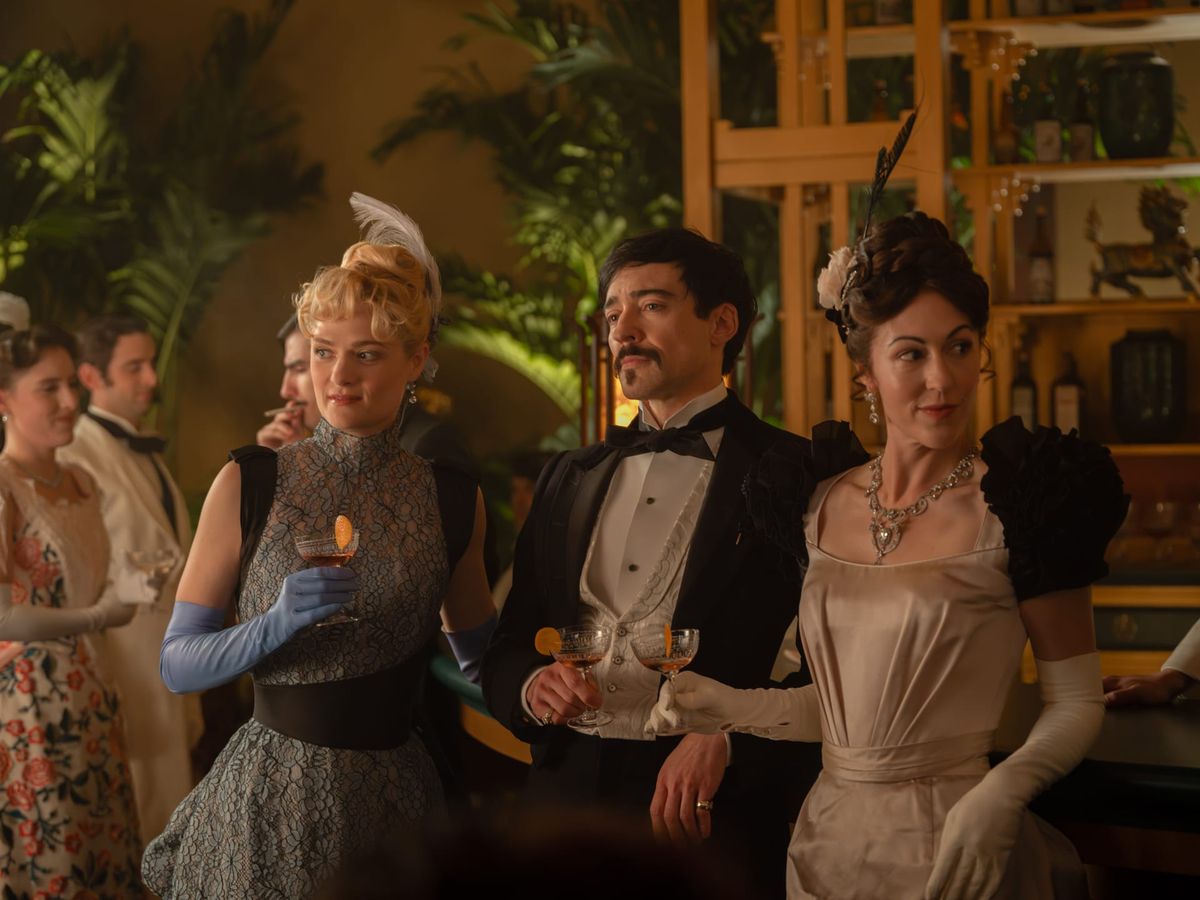
As for Larry and Marian, they have gone slumming downtown after Oscar and Enid’s big society wedding. The youth have their own culture, and it has the fin de siécle energy that their elders simply have no use for, all cancans and mazurkas! Against her better judgment, Marian allows herself to be seduced by how gay it all is (pun intended); “Dance halls are quite marvelous,” she admits. But it’s apparently not so easy to move from the old world to the new at will. Wrecked on the shores of the St. Denis Hotel on Broadway, Marian succumbs to temptation and spends the night with Larry, only to wake in the morning on the brink of ruin yet again, something Larry seems to have trouble grasping. As he told her when she learned of his visit to a disreputable locale last season, it’s only a bit of fun; all men do it. When she does make her way back into the world that holds her only hope of a future, Aunt Agnes praises her for not coming home with Larry after their emergency stay, which would be exactly the sort of thing that would feed the gossip mills. “This is exactly the sort of thing that can ruin your reputation,” she says, in congratulating Marion for avoiding that fate.
The rapidly approaching future is also in evidence in the telephones being installed in the Russell mansion (Larry helpfully expositing for us that there are already 5000 of the newfangled machines in New York). And Jack, thrown headlong into high society by the wealth his clock invention has brought, finds himself having to backtrack to discover the manners of the past that his new peers, Harvard men or Yalies alike, all take for granted. The changes in social mores that Bertha championed at the Newport Ball won’t stay nicely contained in invitation lists, and it’s a matter of perspective whether those changes are forward-thinking innovations or steps down the road of degeneracy.
Let’s talk about Oscar and Enid, because this is being set up as a major driver of plotlines this season. Their scandalous partnership, designed to allow them to exchange benefits (social standing for Enid, money and a beard for Oscar), can also be a launching pad for a new kind of society—a younger, artistic, avant-garde kind, like the salons of Europe. Musicians, authors, bohemians of all kinds, can bring their freer ways of thought (and ways of living) into the stately former Winterton estate. How secret can Oscar’s secret be kept in such company? Contrast his closet with the one Enid is more than happy to throw open the moment Agnes inquires. Wealth and a good marriage cover many sins, even the ones Agnes finds unforgivable.
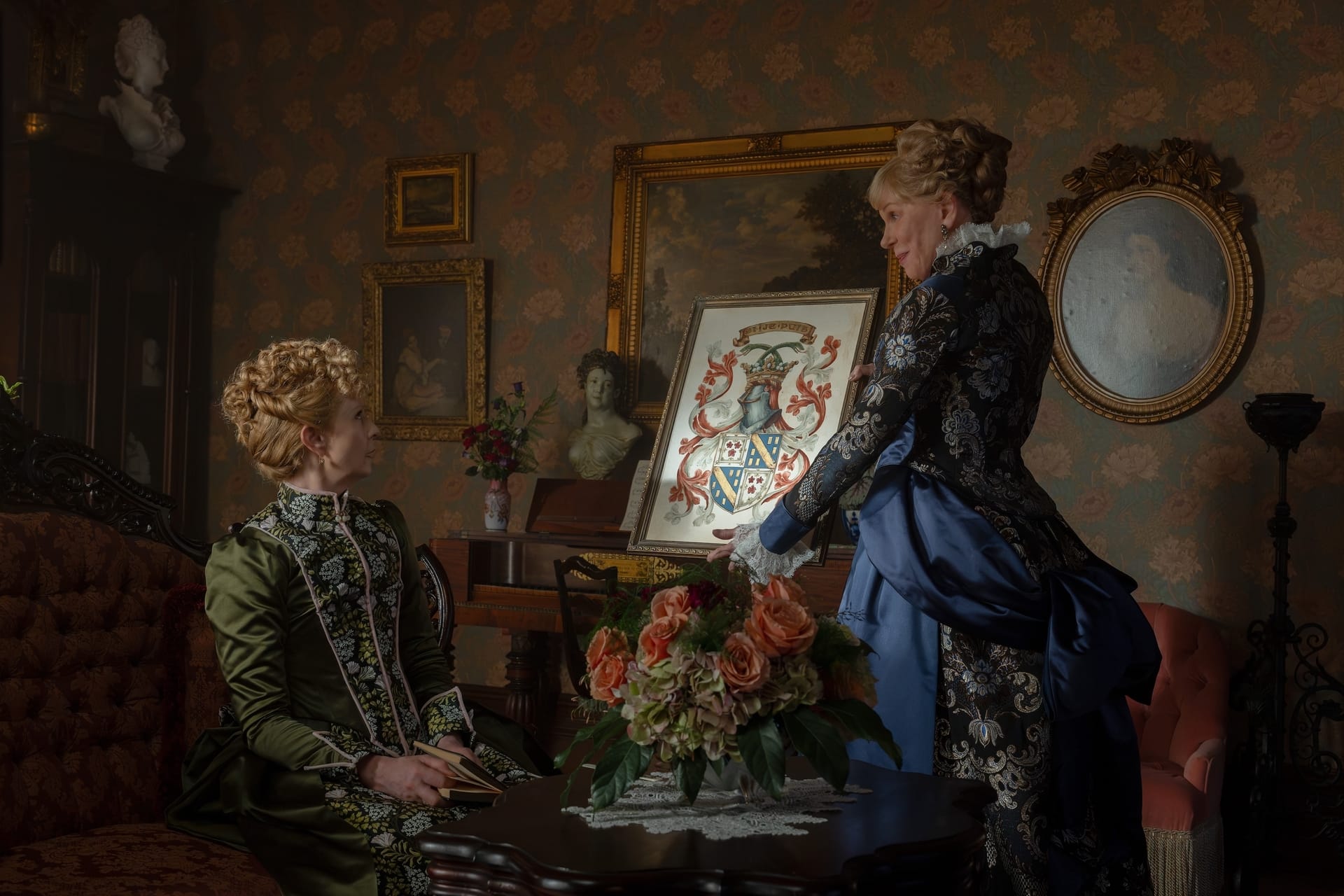
The other event that gets an introduction worthy of a multi-episode arc here is the dinner Agnes is hosting for Grover Cleveland, as part of her participation in the Heritage Society. Those of you who are tired of the bickering about money between Ada and Agnes are surely disappointed to discover that it hasn’t been put to rest. Agnes needs funds to put on the show that will restore her as part of the city’s (and country’s) sturdy and sumptuous fabric, a position she’s found precarious due to her penury, but Ada cuts her off quite abruptly—rather too abruptly to feel true to the relationship. It’s all in the service of setting up the unlikely alliance of Agnes and Enid, who offers her resources to replace Ada’s.
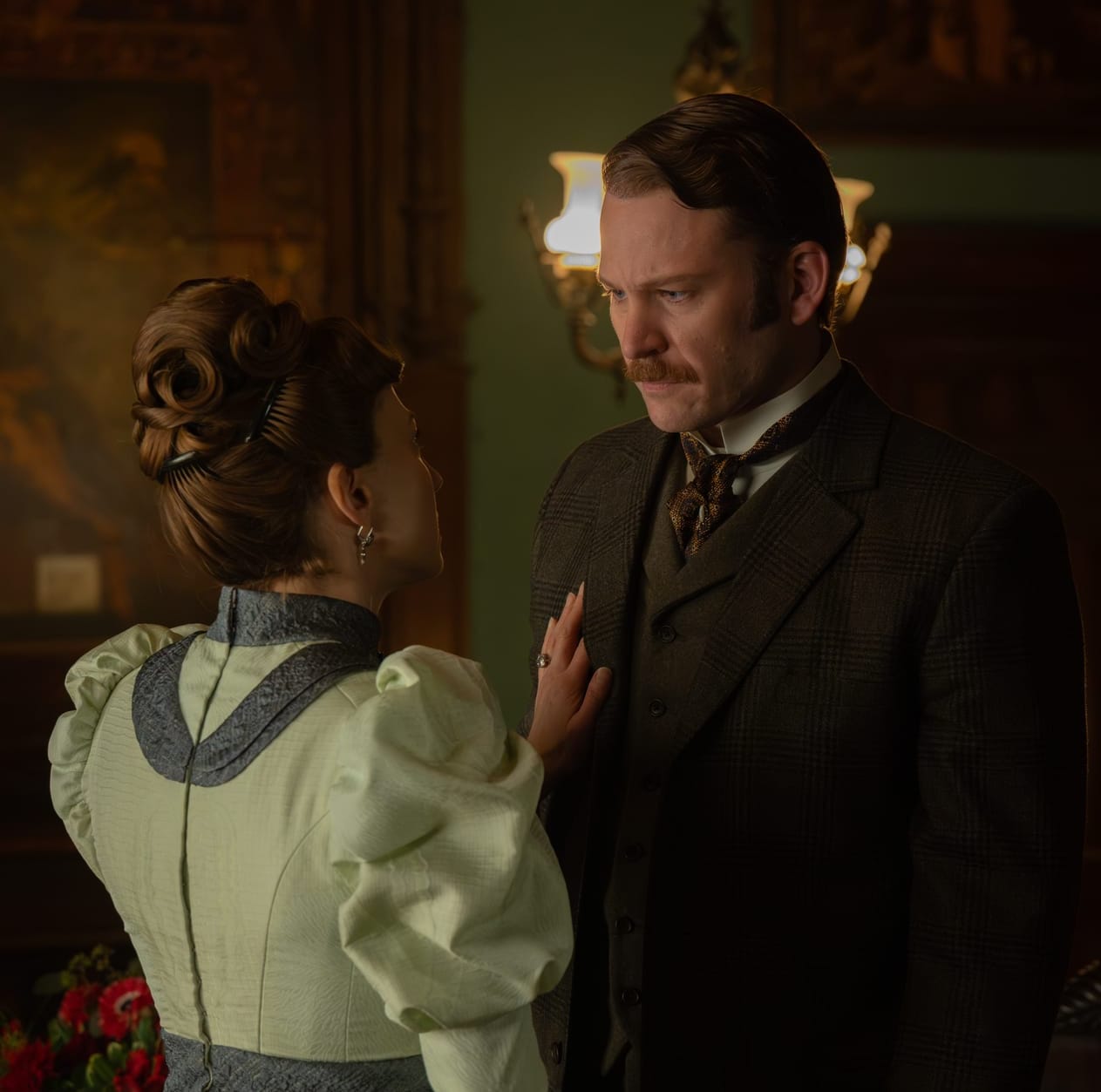
And I haven’t even gotten to Peggy’s upcoming nuptials in Newport (with Mrs. Kirkland micromanaging every detail, and if Peggy thinks all that will be over once she and William are married, she’s fooling herself), a potential new servant downstairs (as Agnes puts on extra staff for the presidential visit), George cornering the would-be assassin with the help of the Pinkertons, and, in what may be the most poignant portent, Gladys being kept in the dark about her inability to bear more children. Season 4 picks up right where Season 3 left off, aesthetically and structurally: short scenes, rapid cross-cutting, crowds and clamor, audacious camerawork, the social whirl masking the profound isolation of so many of these characters. I’m not fully on board with the direction some of the relationships seem to be heading—Marian careening from prude to libertine to ruined woman, George and Bertha seemingly headed for a return to normalcy thanks to the Duke’s fortuitous devotion to their daughter, Larry naively rolling through life in his nepo baby bubble—I revel in the return of the series’ singular pleasures: beautifully dressed people in richly appointed locales eloquently cutting each other dead.
Stray observations
- The opening credits (which I would never skip) have changed a bit, with a shot of the Newport seaside and a new bejeweled throat (Enid’s?) being revealed as servants take away a cloak. I do lament that the timing has changed so that Bertha’s flowered dress doesn’t emerge from the opening roses at the climax of the music, but a measure or two before.
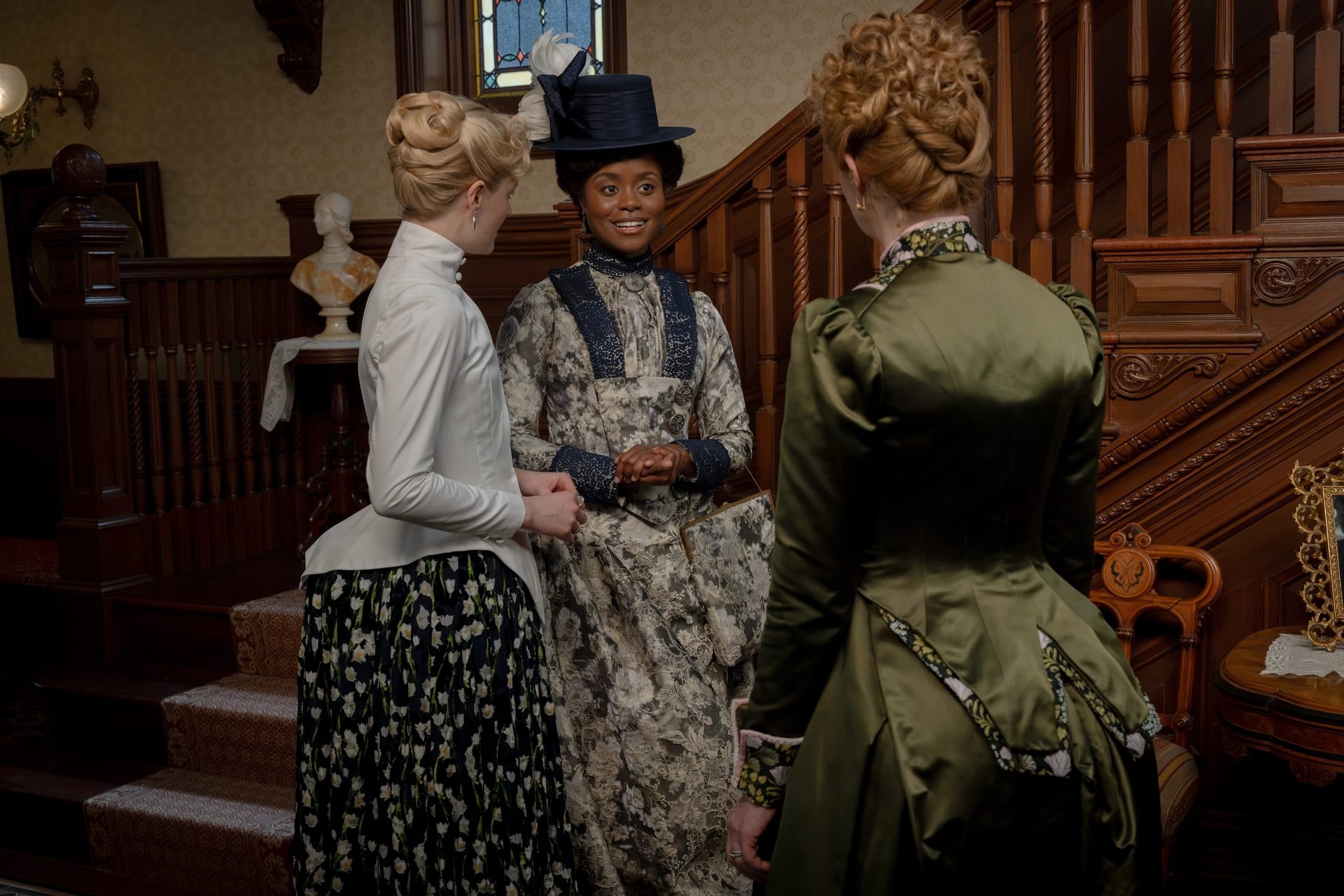
- Peggy sets up Ada to spoil Agnes’ big moment in a non-financial capacity, by providing her with evidence about black America’s opinion of Grover Cleveland. I look forward to the scene where Ada interrogates the president about measures to curb racial violence.
- Surely it won’t be long until Mrs. Kirkland puts pressure on Peggy to give up her writing. She refuses to give even a passing glance to the newly published copy of Friends in These Times that Peggy shows off so proudly.
- Who else thought that Mrs. Armstrong was going to spill something about Oscar’s love life to Agnes, instead of just seething that a fellow servant was ordering her around? (“If I have to wait too much longer for a grandchild, I may not have the strength to pick him up!” Agnes remarks at the reception, quite oblivious.)
- In Chicago, Larry got to see the new steel-framed Home Insurance Tower of Chicago. “It seems to pierce the sky!” he enthuses, coining the phrase “skypiercer,” which is what we all call them now.
- The sign of Jack’s inability to mingle in snooty society is not knowing how to eat an artichoke. I did the same thing as him when my parents served artichoke at some dinner party; luckily I was at the children’s table.
- Jack’s invention is a stand mixer with variable speed and attachments for different functions. Back in Season 3 Episode 6, we saw him showing some sketches of improvements to the venerable Dover egg beater. Indeed, the first motor-driven mixer was patented in 1885 by R.M. Eastman.
- Good riddance to Lady Sara, who tells the doctor to save the baby if it comes down to a choice, declines to hold her grandchild, and swiftly thereafter relieves the Duke and Duchess of her company.
- I hope we’ll get to see much more of Mrs. Foster, who regales the presidents’ representative with the story of the time the Heritage Society hosted Rutherford B. Hayes. His wife was a Methodist!
- “We’ll serve … cocktails!”

Comments ()