
Review: Ted Lasso, "Home" | Season 4, Episode 1
Apple didn't need to be convinced Ted Lasso should return, but does the audience?
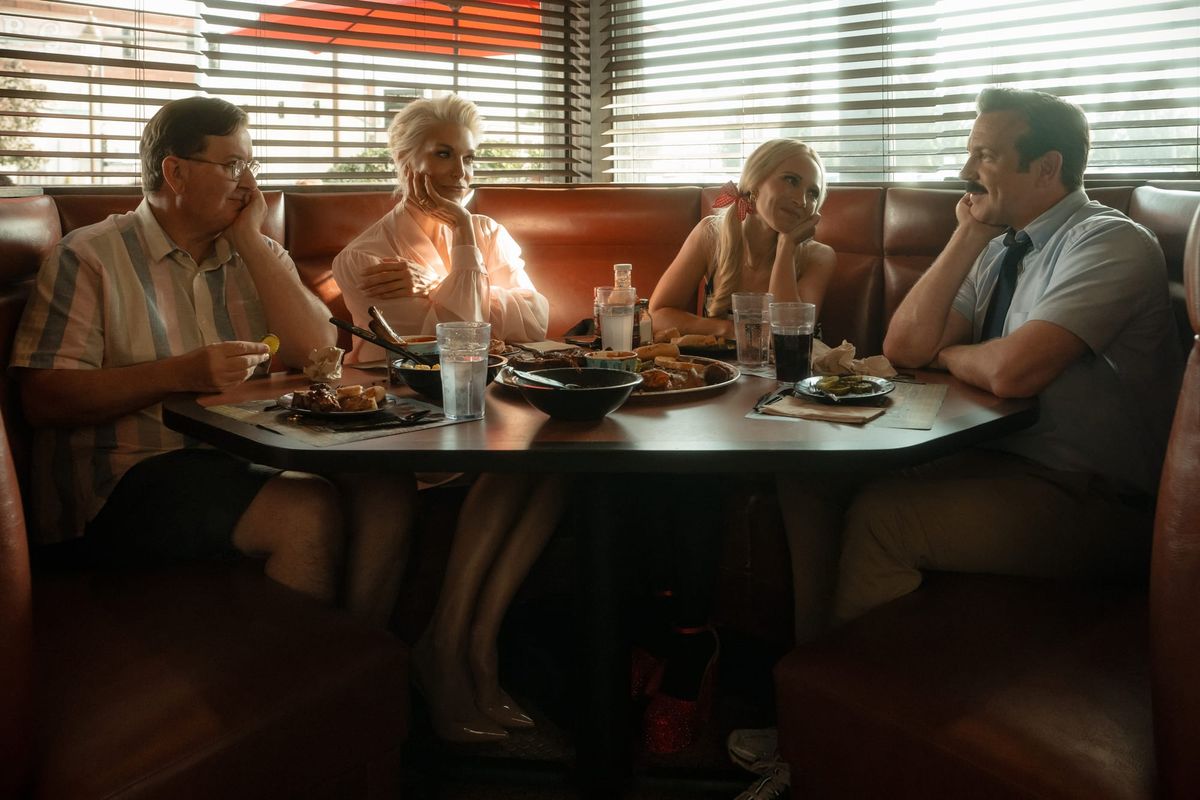
Welcome back—surprise!—to Episodic Medium's coverage of Ted Lasso. As always, this first review is free for all, but subsequent reviews will be for paid subscribers. To be part of the conversation and support our work, consider joining us.
If we operate under the presumption that Apple TV exists five years from now, imagine someone purchases their first Apple device and activates their free trial of the company’s streaming service. They’ve not really been paying attention to TV much, but they figure they might as well use it, and so they scroll through the offerings before landing on one they find interesting: a sports comedy called Ted Lasso that they remember hearing good things about.
How they’ll respond to the show is as always a matter of personal taste, but what I want to think about is what happens when this hypothetical viewer gets to the end of the show’s third season. They’re going to see Ted walk away from the job and team that defined the show, returning home to Kansas City to be a father to his son Henry. It’s a decision born out of Ted’s complicated relationship with his own father, developed across multiple seasons, and as viewers we have to accept that AFC Richmond will go on without him.
Except that for this imagined viewer, they’re going to finish season three and then immediately click on season four. For them, “So Long, Farewell” will hardly be an ending, because “Home” is going to autoplay immediately after. They’re not going to know that the show was famously planned for a three-season arc, and that Jason Sudeikis was steadfast as the third season concluded that the story was done. They didn’t see the news stories about the options on the supporting cast being renewed in spite of this, or the eventual news cycle when Apple formally announced plans for the show to return. They’ll just be moving onto the next phase of Ted’s journey, and unless they’re looking for it on the menu they might have no idea there were three years between the two seasons (which, because of Euphoria, isn’t even the year’s longest break).
I’m interested in this viewer mostly because “Home” is doing something that serialized television shows have often done, but within a context where we as the audience—for me, at least—have too much information. It is a longstanding tradition for a show to disrupt its status quo at the end of a season before then having to find its way back to equilibrium. An example that came to mind for me immediately was The O.C., which sent Ryan Atwood away from Newport at the end of its first season. You know that Ryan’s going to have to be back in the Cohen’s pool house shortly into the show’s second season, because that’s the show; you just don’t know exactly how he’s going to get there, or what will have changed in the process.
If you view “Home” through this lens, and imagine a viewer with no knowledge of the show’s false ending, there’s potentially a sense of discovery here. When we find Ted as the assistant manager of a grocery store, he’s not necessarily unhappy: he’s even extending his teaching to his younger employees, staging an elaborate food heist to help guilt Tyler into putting back the cigarettes he pocketed. But when a former (American) football player recognizes his coach and role model, it reminds him and us of his real calling. The same is true when he’s talking to his ex-wife Michelle outside Henry’s school and gets distracted by the (other) football being played nearby. If you don’t know where this story is going, you know that this can’t be Ted Lasso if Ted Lasso isn’t coaching. When Rebecca, Keeley, and Higgins show up on his doorstep, it’s the first step in his return to Richmond.
I suppose what unites me and this hypothetical viewer is that I don’t think either of us believes that Ted will stay in Kansas City, but the difference is that I went into this episode knowing exactly what that would entail. I knew what Rebecca had been trying to reach Ted about, because it was part of the press release when the season was announced, and of course heavily featured in the trailer for the show’s return. That trailer is notable for completely ignoring everything in this season premiere, skipping directly to the exciting new premise with no glimpse of how Ted gets there. Will viewers without access to that extradiegetic content feel the same way? Will the brief glimpse of Keeley’s plans for a women’s team embedded in the maybe real, maybe a dream montage at the end of season three have stuck with viewers enough that they would connect the dots? Perhaps I’m wrong and this imagined viewer will also spend this forty minutes checking their watch and wondering when we’re going to just jet back across the Atlantic so we can get to the actual show.
I’m confident that I’m among the more cynical critics when it comes to Ted Lasso, given I expressed a lot of reservations about the show’s narrative and character work during my reviews of the second season at The A.V. Club before it became a larger chorus in the third. I don’t consider myself unmovable, but I’m certainly someone who would have been content to see the show stay dead, and on some level “Home” is responding to my positionality. Sudeikis knows he killed Ted Lasso, but now needs to prove to audiences that there’s a creative reason to return, and not just a chance for Apple to pad its Emmy nomination count. The first step in that process is getting Ted back to England, and that requires removing the barriers that brought him back to Kansas City in the first place. This episode is the writers’ argument for why Ted would be willing to return to a job he left behind.
It may just be the cynicism talking, but for me it’s an inherently empty task because Ted’s justification for leaving was mishandled in the first place. Putting aside the weird dynamic between Ted and Michelle in the third season, where his attempt to move on from his divorce was replaced with major reconciliation vibes after she started dating their marriage counselor, his return to Kansas City felt arbitrary. We knew it was the end of the show, and so Ted made a decision that ended the show, without ever really exploring other alternatives. The idea that Ted would give up not just this specific job but his entire career in order to co-parent Henry is selfless in a very Lasso-like way, but it also robs him of so much of his identity, and registered as bittersweet in ways I’m not convinced the show reckoned with (see: Ted not even showing up at Beard’s wedding).
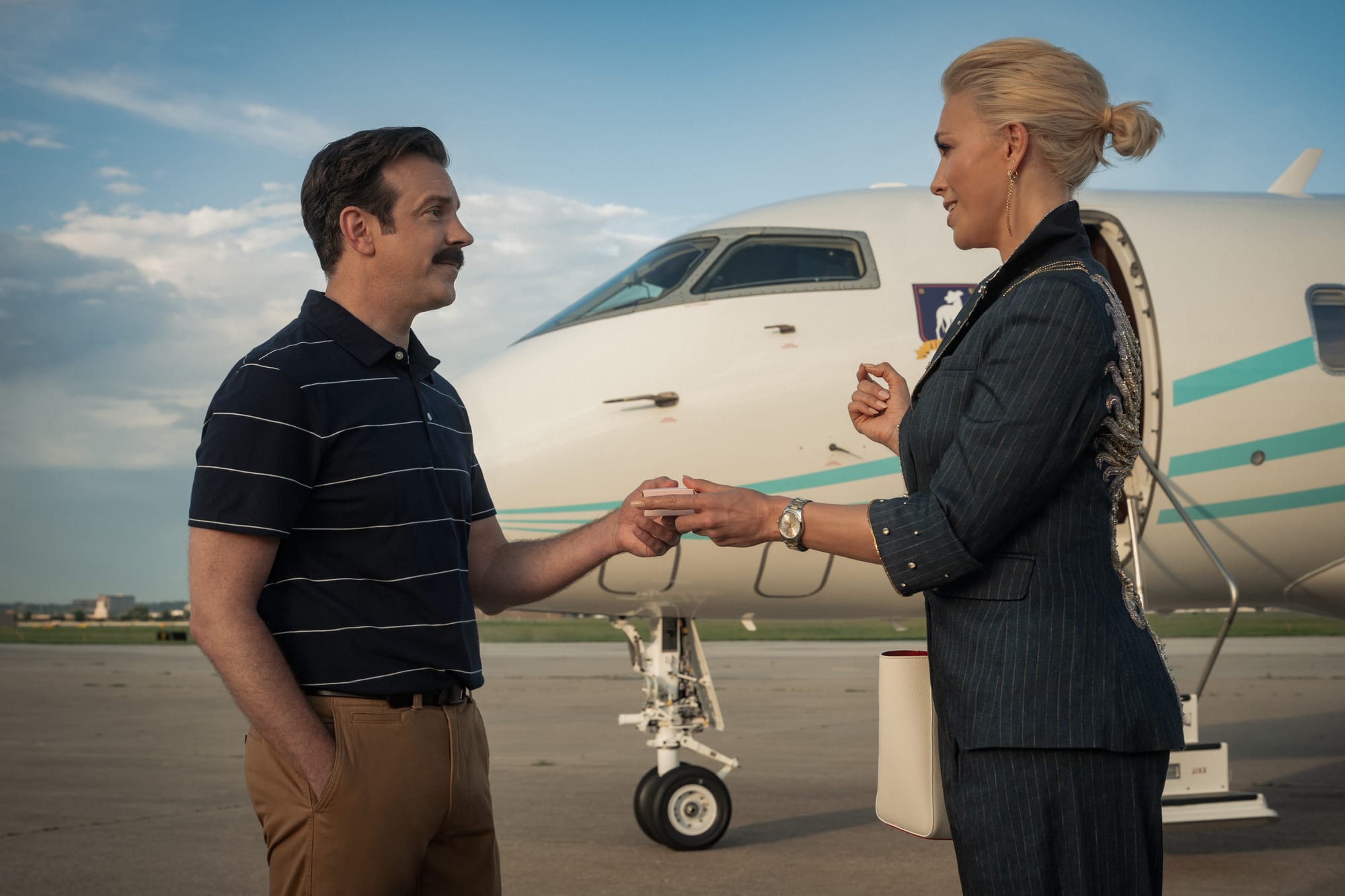
As a result, when I realized that “Home” was going to spend 40 minutes on Ted weighing Rebecca’s offer to coach the women’s team, I knew this episode wasn’t for me. I don’t need to be convinced that Ted would or should take this job. I don’t need him to work through all his feelings, and I certainly don’t need the show to stack the deck to make it so he’s the last person to realize it’s the right idea. I’m open to the concept that things have changed in the years since we last saw these characters to make the idea of Henry relocating to England more acceptable: he’s graduating from his current school, for example. But the show doubles down by making sure we know that Michelle is miserable at work (we never even knew she had a job before this, I don't think), and his mother is moving out of her house and into a reasonably sized condo in a senior living community. Every obstacle that kept him from staying in England is removed, and only then can he see that his own happiness in his work might be as important to raising his son as anything else.
And, like, duh? Admittedly, I’ve had over a year to process the idea of Ted Lasso returning, but so much of the work being done here felt extraneous to me. I didn’t need Higgins to learn the history of the Negro Leagues to make me think about the themes of inclusion, and a visit to the KC Current game wasn’t necessary to make me understand the excitement surrounding professional women’s sports in our current moment. The episode acts like it has to do so much work to get Ted to the point where he can take this job, but the problem is that I was already ten steps ahead of him, and I just wanted him to get on with it. I acknowledge it’s true to his character that he’d have blind spots around parenting, and the episode plays (too) heavily on his daddy issues, but that doesn’t mean it isn’t narratively frustrating to know he’s going to say yes and having to watch him hem and haw until he sees the requisite number of mementos from his past.
“But Myles,” you ask as you read this, “if they had just hand-waved away all these issues in ten minutes and jumped straight into what’s being held for the second episode, you would’ve complained about that.” That’s probably true (know thyself), but the difference would have been that then we would have had a clearer thesis statement for what the show wants to be moving forward. I would have accepted the necessity of hastily undoing the forces that sent Ted back to America because it would get us to Richmond, meeting the new characters that will populate this story. We get some of the contours of that story in the scene with Rebecca and Higgins: another women’s team has already folded, setting up financial stakes in conflict with Keeley’s big ideas, while exposition gives us Alice Chilton waiting in the wings as a prospective coach for the team (and likely foil for Ted). There’s a show there! I’m interested in watching more of that show! I resent the fact that I had to sit through forty minutes of Ted waffling about it to get there.
It raises a larger question about what the show wants to be moving forward: is this still a show built around Ted Lasso’s psyche? The show began in a place of Ted as the unfailing optimist, and over time revealed the pain underpinning that idea. He only took the job at AFC Richmond because his marriage was falling apart and it allowed him to escape that reality. His journey with the team unearthed the trauma around his father’s death, and created the conditions for him to understand how his ability to help people as a coach didn’t necessarily translate to helping himself. The reason Ted Lasso ended was that Ted Lasso’s specific journey as a character had reached an endpoint, and “Home” spends its runtime arguing that it’s returning because there’s a new journey to be had.
But is it about him? I would argue that the best thing “Home” does, even if it doesn’t have the space to really emphasize it, is center Keeley within the work of the women’s team and thus the show. Rebecca is supportive of the idea, but it’s Kelley who delivered that proposal to her in the montage last season, and it’s her enthusiasm that's the driving force. The siloing of Keeley away from Rebecca and the team was maybe the third season’s worst decision, and I’m much more excited by the prospect of more Ted Lesso if the show is anchored on her emotional journey as opposed to Ted’s. It doesn’t make sense for a show about inclusion in sport to remain centered on the white dude, which is why it’s frustrating to have the beginning of the show’s new era so weighed down by Ted’s personal life.
“Home” is an effective episode in terms of what it sets out to do: by the end of the episode, you believe Ted would ask Michelle and Henry if they wanted to move to London, and you believe they would say yes. But while that will creates its own challenges, I refuse to believe that Ted’s personal life will be the driver of this story, which makes the time we spend with it seem fundamentally unnecessary. He’s not going to London to find himself like he did back in season one—he’s going to do what he loves, and what he’s good at, and the show’s stories can and should come from the way a new set of characters adapts to the Lasso Way. “Home” doesn’t get to do any of that work, doing little to answer questions about the choice to return to this world. It’s nice spending time with these characters again, but the raison d’etre of the season remains on the other side of the Atlantic, and until we get there it’s hard to know if a new journey is worth one’s time.
Stray observations
- I know why Rebecca has to still be in a happy relationship with Matthijs given where the third season ended, but I’m still kind of resentful about everything about that Rebecca story, and he’s very boring. If having a long distance pilot boyfriend keeps her stories from devolving into “women must be defined by their romantic lives,” I’ll allow it.
- Why would Ted get a job at a grocery store? Wouldn’t there be a coaching opportunity somewhere in Kansas City, or did he consciously deprive himself of that (or feel it would take up too much time)? Is he talking about any of this with an actual therapist? His initial hiring was a major news story, but what about his departure?
- There’s a lot of specific Kansas City details here (like the Jazz Museum and the Negro Leagues museum sharing space), but they did invent a gaudy clothing boutique for story purposes, let the record show.
- We don’t get an opening credit sequence, since I suppose the show wasn’t officially Ted Lasso yet, but we still get a bit of Marcus Mumford with “Kansas City,” from his participation in The New Basement Tapes. It’s a fortuitous bit of overlap, even if the montage it soundtracks was a bit of a breaking point for me. He also just played the song—and the Ted Lasso theme—in concert in Kansas City this week.
- “I finally watched Breaking Bad. Hilarious.”—I don’t know if I have a clear handle on why they’re using Rebecca thinking Breaking Bad is a comedy as a character detail, but I chuckled.
- Even if we hadn’t seen Brett Goldstein with his Roy Kent beard on Shrinking this season (or seen the trailer), he’s the unseen character that the show discusses most directly, returning us to the will they-won’t they with Keeley (who says they’re just friends, but Ted immediately questions if Roy feels the same).
- He’s in the trailer, so we know Coach Beard is coming back, but it’s a bit strange to me he wouldn’t be part of this conversation? Although, I suppose Ted didn’t even go to his wedding, so maybe they decided to use that as justification.
- Welcome back to our coverage of Ted Lasso. For all my frustrations with seasons two and three, the sheer power of that first season continues to create a lot of possibility in this universe, and hashing it out with our subscribers was a real highlight of the early years of Episodic Medium (and not just because the paywall meant I wasn’t pilloried for my cynicism). Excited to discuss the actual show Ted Lasso wants to be once we get into it next week.
Comments ()