
Review: Star Trek: Strange New Worlds, "Valles Marineris" | Season 4, Episode 1
The gang is back, for better and worse
Welcome back to Episodic Medium’s coverage of Star Trek: Strange New Worlds. As always, the first review is free for all, but future reviews will be exclusively for paid subscribers. Support our contributors and join the conversation by clicking below.
At its heart, Star Trek and its various spin-offs are workplace dramas. That’s not all they are, obviously, but that’s the core of the appeal: watching people you grow to like and respect doing weird things for the sake of science and (sometimes) the fate of the universe. What’s frustrating about the modern era of Trek is how regularly the creative teams seem to forget this basic fact, choosing instead to present stories in which characters with the maturity of high school sophomores find their emotional problems translated into broad, condescending metaphors. It’s a bit like Buffy, only everyone is way too old to still be acting this young, and the metaphors are never complex enough to be actually interesting.
For a while, at least, Strange New Worlds seemed to have avoided this trap. It was corny from the start, sure, and not every idea was on point, but the core of the series went back to what had made the franchise so compelling to begin with. We had Captain Pike leading his crew of fresh-faced professionals into various dangers, with just the right balance between personal drama and big picture threats. The comedy was often surprisingly funny, the characters were well-drawn and acted, and you never got the sense that the universe was revolving around any particular person on the Enterprise.
The cracks were always there, of course. There were tonal issues, forced jokes, bizarre backstory choices, and a fundament shallowness when it came to world-building. But these were easy to overlook when the cast was this charismatic, and where it seemed like the heart of the thing was in the right place. Maybe lowered expectations also played a part. As good as Anson Mount and Ethan Peck had been on Discovery, I went into the SNW pilot prepared for the worst, and the pleasant feeling of surprise persisted for much of the first and second season.
Last season wasn’t great, though. The stories got sillier, the romantic entanglements more forced. A compelling “will they/won’t they” build-up between Spock and Nurse Chapel turned into a “well I guess they are” between Spock and La’an, as though Spock’s love life was something that needed constant narrative maintenance or we might lose interest. Worst of all, the season ended with a plot leaning into modern Trek’s worst impulses, with Captain Pike’s girlfriend getting sucked into a fantasy narrative about a mystical evil and a lot of talk of “destiny.”
I thought this was terrible; and worse, it was terrible in a way that implied the show thought it was really onto a good idea. The series appeared to finally have succumbed to the Kurtzman Curse, and the fact that we learned we only had a season and a half left before SNW would be over completely felt at once arbitrary and maybe not soon enough. In a perfect world, we’d get to watch this cast hang out and explore for 20+ episodes a season; and sure, there would’ve been dud episodes, but it wouldn’t have mattered as much as it does in a ten episode season.
All of that preamble is leading up to my sort of but not really positive reaction to the season four premiere, “Valles Marineris.” We do get a sci-fi premise, thankfully, and it’s a covert riff on the classic “City on the Edge of Forever” from the original series, although it’s probably best if you don’t think of it on those terms. There’s a germ of a neat premise at work, but the script mistakes scope for impact, and the results are interesting in the moment, but appalling if you think about them for more than a minute. Which, unfortunately, is another modern Trek problem.
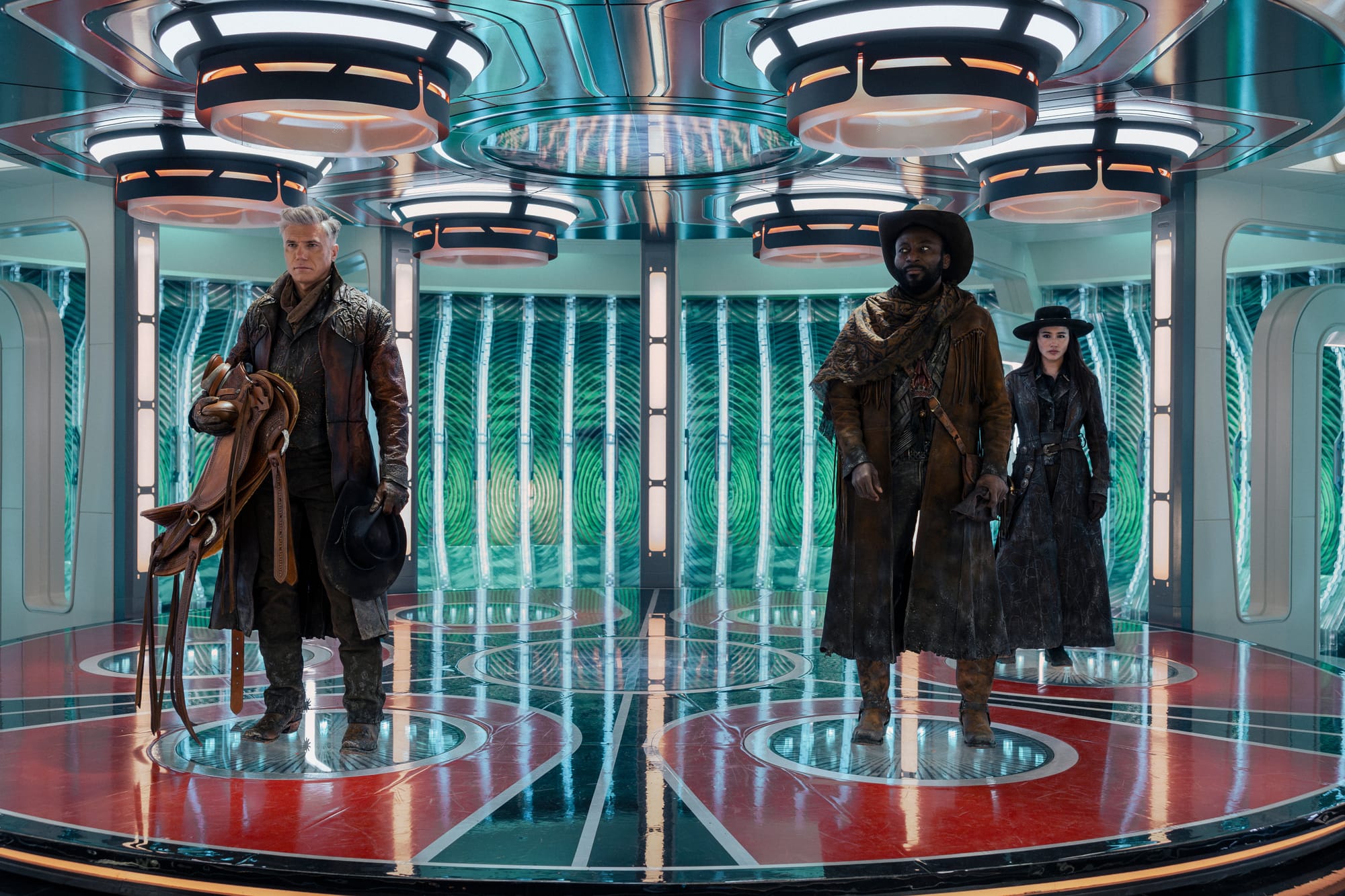
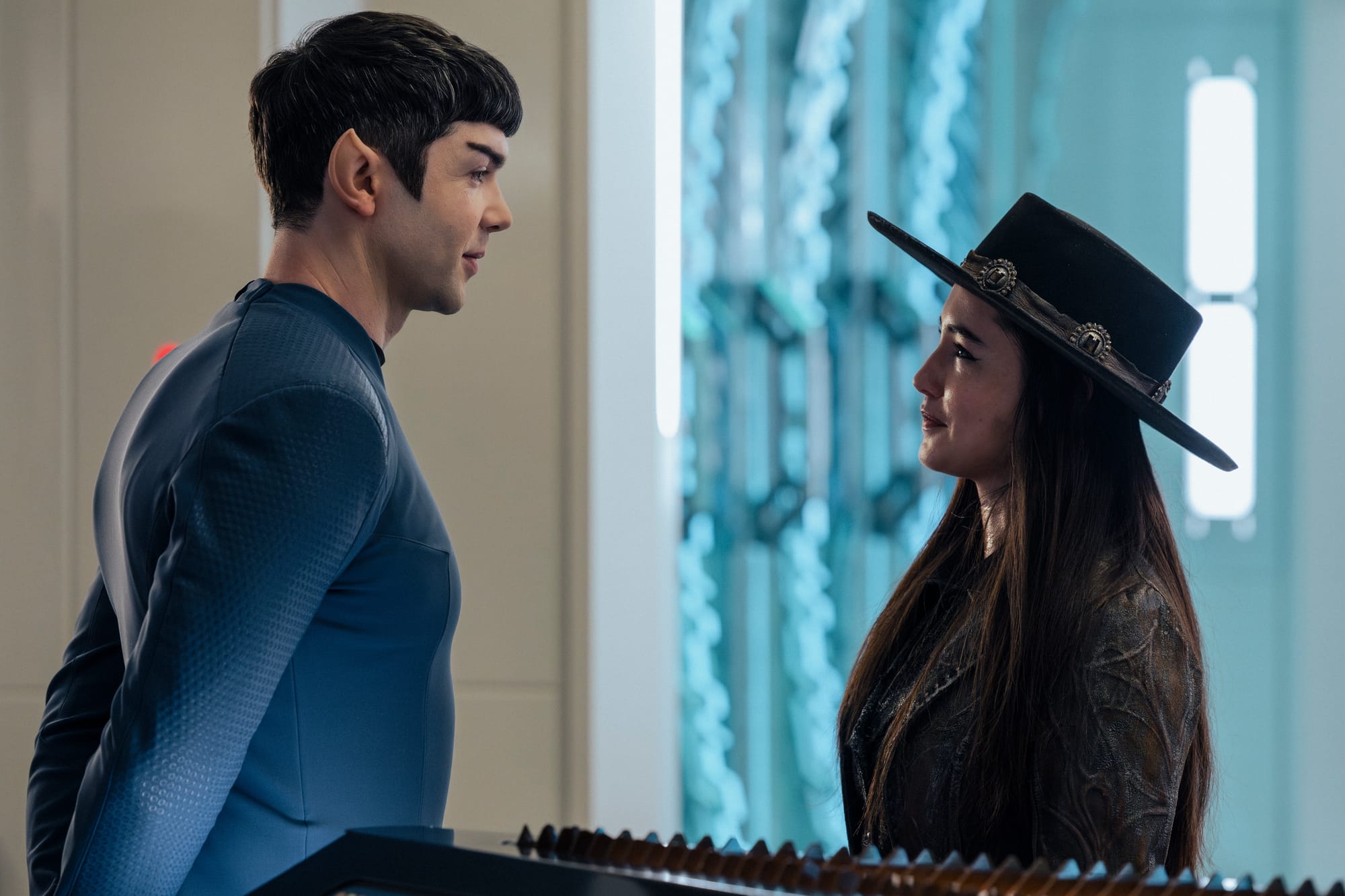
There’s also some talk of work-life balance, which reads as deeply absurd. Pike has, apparently, been throwing himself into his job in order to get over the loss of Batel, and Una gives him a friendly lecture on pushing the crew too hard. This would land better if the episode hadn’t literally opened with Pike, La’an, and M’Benga riding horseback while dressed like extras from Hell On Wheels. Later, when they beam back to the Enterprise, Spock is so horny for La’an in her cowboy gear that he meets them in the transporter room, and the two immediately head back to her quarters to hook up.
The problem being, if Pike is working everyone so hard, shouldn’t they be unhappy about it? Shouldn’t we get the sense of people feeling pressured and exhausted, instead of the usual horny good cheer? It’s a small issue, and not one I’d normally harp on, but at this point, the show has lost a lot of my faith in it, and I find myself being bothered by things that, in earlier seasons, might have escaped notice entirely.
Take the slight subplot about Uhura being excited to have a new mentee. Would you be surprised to learn that said mentee is a Vulcan? And would you be even more surprised to find out that she’s not particularly keen on Uhura’s concept of mentoring and professional friendship? Lower Decks did something similar in its later seasons and it was silly there too, but at least that show’s a comedy. Here, we get a stereotypical Vulcan saying stereotypical “Vulcan” things, and Uhura being completely baffled by it. It’s supposed to be funny, but it’s so predictable and trite that it barely registers. Uhura is supposed to be a communications genius. Surely she would have researched enough about Vulcan culture to understand “let’s be pals” wasn’t going to work well for her here.
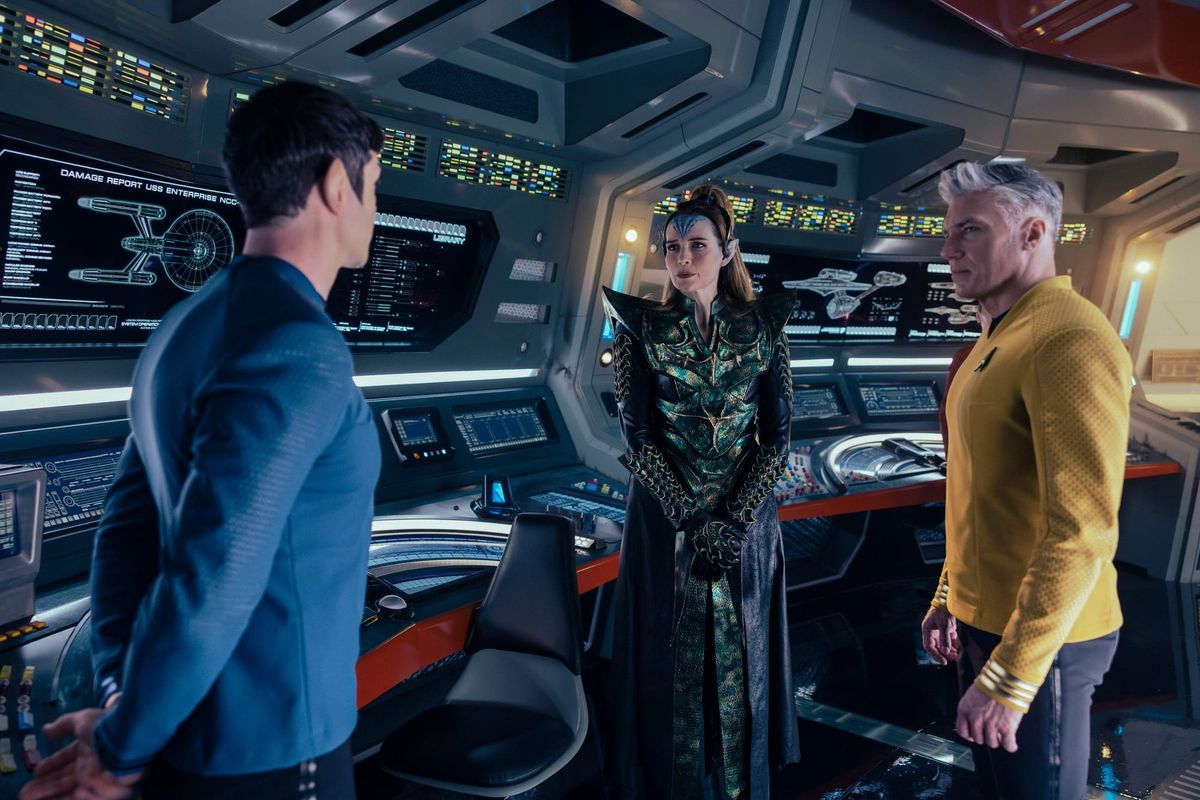
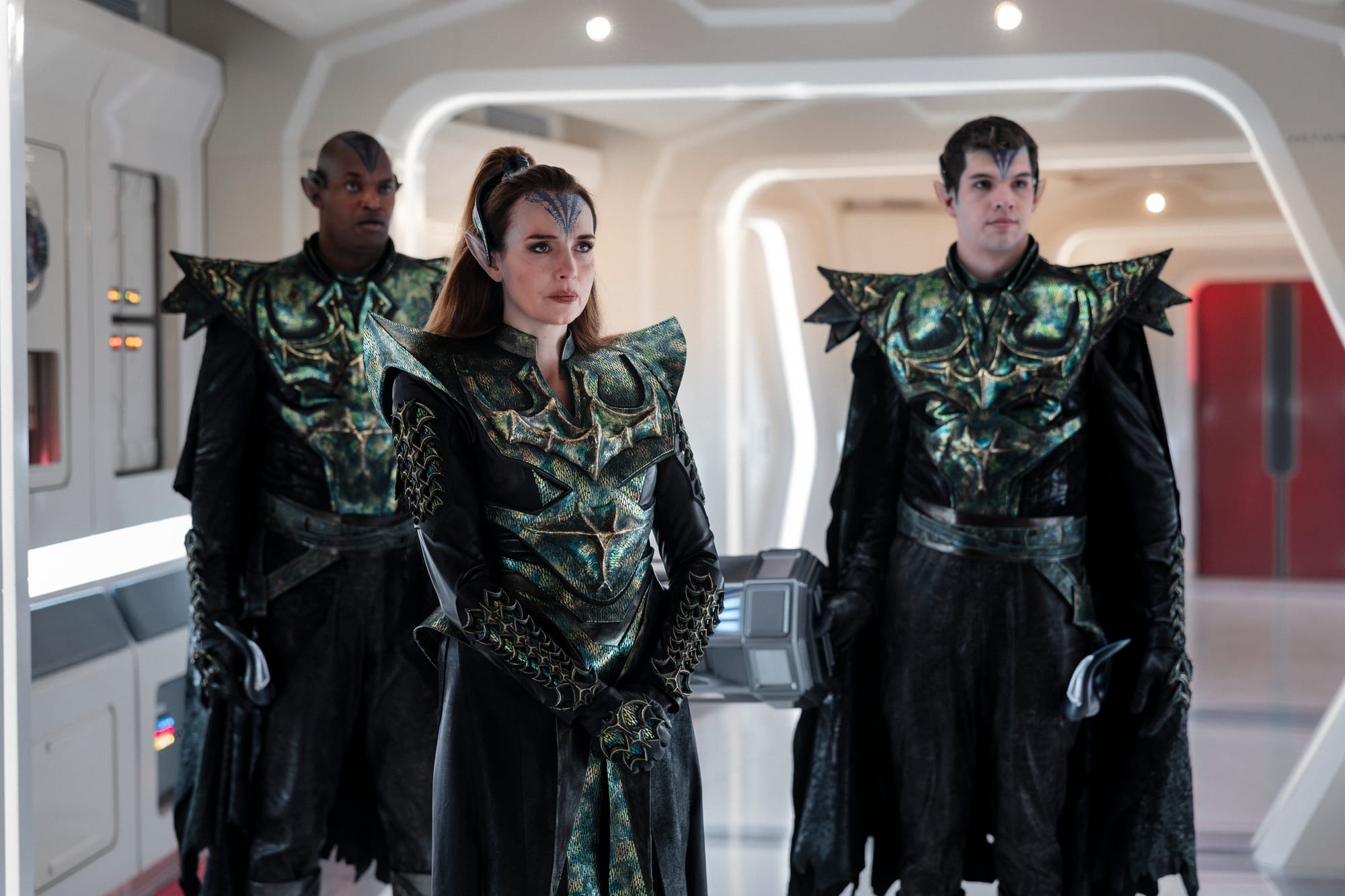
What makes all of this particularly galling is that “Valles” is a time travel episode, and I usually love time travel episodes. In this one, the Enterprise responds to a distress signal inside a cosmic storm, only to find themselves flung back 65 million years into the past. While Una, La’an, and Ortegas head down to a planet (it’s Earth) to retrieve a mineral needed to run the ship engines, the Enterprise finds itself captured by a powerful Martian ship, forcing Pike to negotiate with a warleader looking for an advantage in her battle against an insectile race.
There are good ideas here, and watching our heroes struggle to find a way to temporarily stun a dinosaur that’s blocking their path is goofy fun. But the meat of the episode is about a philosophical debate between Pike and Cassell, the Martian woman; he argues for peace, and she can’t understand what seems to her to be his essential naivete. It’s not bad as far as these debates go, because the episode is smart enough to make Cassell into a reasonable person–she goes to extremes, but it’s not difficult to understand why she feels she has to, and the episode never makes the mistake of turning her into a cackling villain.
Unfortunately things fall apart at the climax of the episode: Cassell steals some tech from the Enterprise and uses it in a suicidal attack on the bug’s homeworld. Pike has a chance to stop this, but choose not to when he realizes that the planet Cassell is firing on no longer exists in the future. By allowing the deaths of millions, he’s theoretically ensuring the existence of the human race.
As I said, this has echoes of “City on the Edge of Forever,” where Kirk has to let an innocent woman die in order to ensure America would still get involved in World War II. Ideally, we’re supposed to be horrified and fascinated, marveling at the merciless complexity of temporal logic and wondering if we’d be able to make the same choice under similar circumstances.
It’s just, the way “Valles” handles the issue is shallow and far creepier than anyone involved seems to be aware of. For one thing, there are no real stakes for Pike in making his decision; we never see the insect species “in person” so to speak, we have no emotional investment in them whatsoever, and Cassell has made it clear that they were the aggressors in the war with Mars. Instead of the devastating tragedy of a man doing his duty against the wishes of his heart, we get a trolley problem with some neat visual effects. It barely qualifies as drama, no matter how many different serious faces the crewmembers put on.
Also, and this is a bit more subjective, but this approach to the universe feels deeply anti-Trek to me. Pike spends the episode arguing for communication between species over never-ending war, only to just sort of shrug when Cassell goes ahead with her plans. Later we are reassured multiple times that this was the way it must’ve always happened; the destruction of the planet changed the orbits in the rest of the system, rendering Mars the wasteland it is now, and also sent out the asteroid that killed the dinosaurs. Apparently, every other time our heroes saved millions of lives, they were doing the right thing, but this time, when they let millions die, they were always doing the right thing.
Honestly, the scope is too big for me to take it seriously enough to be offended by it. It’s like a child’s idea of stakes: if one person needing to die for the future to exist is dramatic, wouldn’t it be a billion times more dramatic if it was an entire world? It’s not, though. What drama there is in the episode comes from Pike trying to get Cassell to come around to his point of view. Once he fails, the whole thing becomes an exercise in “clever” twists, with a meaningless genocide serving as the punchline.
I continue to like these actors and believe this show can be great. This is not a complete disaster of premiere; even at its worst, it’s at least trying to engage with challenging ideas. But “trying” doesn’t automatically mean “succeeding,” and if this a sign of things to come, I’m worried about how bad things are going to get before it’s all over.
Stray observations
- La’an punched a dinosaur. (I’m referring to her as La’an right now because her last name, Noonien-Singh, is too damn long to type.) This means her genetic engineering is kicking in, for some reason. So I guess we get to look forward to Spock losing another love interest.
- Pike is offered a promotion, but he decides he wants to stay in the captain’s chair a little longer so he just tells them to pass it on to Una. Is that how that works? It doesn’t seem like that’s how it should work. (Also, Pike says this puts her “one step closer” to getting her own ship; how many promotions do you need to get before you can sit in the captain’s chair and refuse to ever leave it?)
- I kept thinking of the “Time and Punishment” segment from The Simpsons every time we cut back to Una and the others on ancient Earth. “Oh I wish I wish I hadn’t killed that fish.”

Comments ()