
Review: Elsbeth, “Murder, He Wrote” | Season 3, Episode 16 / Matlock, "Day One" | Season 2, Episode 14
Maybe we *should* just take off our clothes
“I have met plenty of charming monsters.”
Does a work of fiction need to mirror the opinions of the person who consumes that fiction? As much as you hear people talk about whether or not you can separate art from the artist, there’s also a debate about whether or not depiction equals endorsement. If Martin Scorsese depicts criminal activities in a film, is that the same as him endorsing those activities or glorifying them to the point of making people wish they were like the onscreen criminals? (The answer to that is an easy no, to be clear.) But while depiction does not always equal endorsement, and while you can separate art from the artist, it can be thornier as a reader or viewer to engage with some piece of fiction if you find yourself in disagreement with it. We all like to be challenged to some extent, but sometimes you appreciate when a film or a TV show puts forth an argument that you nod to in satisfaction. It’s weirdly, almost inexplicably flattering.
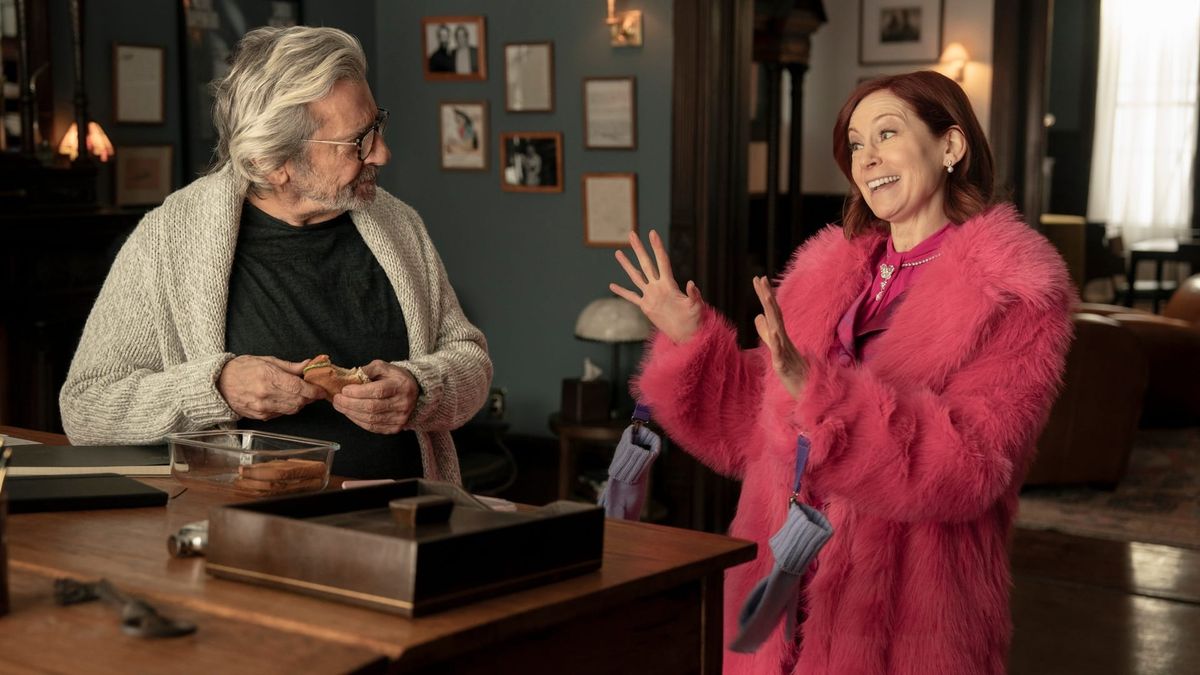
To that end, did I end up liking “Murder, He Wrote” more because a) this week’s murderer seems like a pretty obvious stand-in for the late literary icon Philip Roth, b) the character in question is pretty roundly mocked for his creative peccadilloes, and c) I am not a particular fan of Roth’s work? Well, who’s to say. But it did feel mildly gratifying in the moment. I recall with fairly solid detail a graduate-school literature class where we studied Roth for the entire semester. I also recall finding most of his novels to be pretty exhausting. (Fair is fair: among the books we read in that course was The Plot Against America, which is excellent and disturbing, and also fairly different from a lot of his more self-focused work.) Again, I cannot tell you with 100 percent certainty that Elliott Pope (Griffin Dunne) is a Roth stand-in. But the real man was known for not writing women well, for mining real life for his fictional work, for having left behind at least one aggrieved ex-wife who wrote a memoir about their marriage, and eventually for implications of untoward behavior toward women. And Elliott Pope fits that description to a T.
I also can’t state that the writing team behind Elsbeth was teeing off against the real man here, but the characters are not shying away from criticizing the prolific Pope. Even before the final scene where Elsbeth gets to walk through how she caught Elliott 18 months after he killed a critic, she and Lt. Connor and Grace all tee off on how antiquated his style of writing feels even it has netted him some popularity. In fact, while we hear that Elliott is pretty famous, the majority of people in his life can’t stand his work, not least because he’s not shy about turning them into literary fodder. Elliott, meanwhile, cannot stand criticism. Thankfully, Elsbeth doesn’t attempt to make some straw-man argument against critics, even as it’s Barney Corman (Mark Linn-Baker), a critic and longtime frenemy of Elliott’s, who gets killed this week. What was Barney’s crime? Why, suggesting that Elliott’s latest work in progress is just “another sad masturbatory exercise steeped in misogyny and casual cruelty.”